How Psychology Has Changed Over Time
From Plato to now. Click to view an interactive timeline of psychology’s history from the Online Psychology Laboratory:
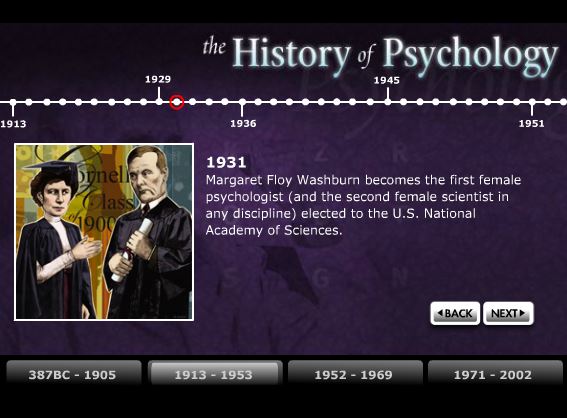
The first Psychology lab was created in 1879, in a University in Germany. The experimenter? William Wundt: known now as the father of Psychology. There, he and other colleagues helped create an new experimental device. His goal was to find measure atoms of the mind.
Eventually, psychology became split into two different sections: structuralism and functionalism. Structuralism was endorsed by Wundt and Edward Bradford Titchener. This view used introspection, or the observation of ones own mental/emotional processes, to examine the structure of the human mind. Functionalism was promoted by William James. It was also influenced by Darwin. This view was focused on how mental and behavioral processes work or function. Specifically, how an individual is able to survive, adapt, and thrive.
Later, Psychology developed many different subfields or perspectives which include:
- Behavioralism
- Freudian/Psychodynamic
- Humanistic
- Cognitive
- Behavior Genetics
- Cognitive
- Gender and Cross-Cultural
- Evolutionary
- Positive
- and more!
Here are some other links for more information and citations:
- Myers, D. G., & Dewall, C. N. (2015). Psychology. New York, NY: Worth Publishers.
- http://www.psychologicalscience.org/publications/observer/2013/november-13/what-we-know-now-how-psychological-science-has-changed-over-a-quarter-century.html
- http://www.psychologycareerzone.com/psychology-career-history.html
- https://www.theguardian.com/science/head-quarters/2014/jan/24/the-changing-face-of-psychology
The Power of a Situation: Prisoner 819 Did a Bad Thing
In 1971, Philip Zimbardo conducted a highly controversial experiment that would become infamous. His research question: Why were prison guards violent? What drove them to violence? Was it their personalities? Was it their environment? In order to study this, Dr. Zimbardo created a prison-like environment in the basement of the Psychology building at Stanford University.
There were 10 prisoners and 11 guards, who were recruited through a newspaper ad (below). These participant were all randomly assigned to their roles, prisoner or prison guard. Zimbardo himself would be a researcher, but also play the role of Prison Warden.

The Prisoners
The participants who were assigned prisoner were actually arrested at their own home. However, there was absolutely no warning (which actually broke the consent form the participants signed prior to the experiment beginning). They were handcuffed, had their finger prints taken, and processed like real criminals would be at the police station. Then, they were blindfolded and driven to the makeshift prison at the university. Prisoners were held in small cell rooms, with two other prisoners. Upon arrival, the prisoners were strip searched, had their possessions taken away from them, and were given prison clothes. On their clothes/uniform, there was an ID code. From that point forward, they were only addressed as their ID number. This is how Zimbardo and the other researchers began the processes of deindividualization, or trying to get the prisoners to lose their sence of self.

The Guards
The guards, on the other hand, were split into groups and given shifts each day. They were dressed in matching uniforms, a club in hand, and dark sunglasses (to inhibit eye contact with prisoners). The researchers told them to do what, in their opinion, was needed in order to maintain obiedience and structure within the prison. Prison guards quickly began to harass and insult the prisoners, verbally, as well as give them demeaning tasks meant to strip them of their dignity.
Prisoners were beginning to follow the rules strictly, in fear of having a punishment given to them. Prisoners became submissive to the guards, which in turn made the guards more aggressive. On day two, prisoners created a rebellion, which endly badly for them. The prisoners were harassed, and the leader of the rebellion was placed in solitary confinement as punishment. One prisoner was actually released after a day and a half into the experiment. He was beginning to show signs of depression. Eventually, other prisoners had to leave the experiment early, due to emotional distress that could have had long-term effects on their psychological state. After six days, the experiment was forced to shut down early.

The results of this study show that the power of a situation can heavily impact whether someone will conform to certain roles or not. These findings support Dr. Zimbardo’s hypothesis of the situation being the strongest driving force for prison guards, rather than their personalities. As for the prisoners, they became submissive because of the deindividualization process and their learned dependency on the guards. They lost their sense of self by being referred to as a number and not having their personal belongings. During interviews after the experiment had concluded, both groups of participants were surprised with the way that they behaved.
Additional Resources
- Haney, C., Banks, W. C., & Zimbardo, P. G. (1973). A study of prisoners and guards in a simulated prison. Naval Research Review, 30, 4-17.
- Psychology and Stuff Podcast: The Stanford Prison Experiment. https://blog.uwgb.edu/uwgbpsych/psychology-and-stuff-the-stanford-prison-experiment/
- Psychology and Stuff Podcast: The Stanford Prison Experiment… Part 2. https://blog.uwgb.edu/uwgbpsych/psychandstuff22/
- http://www.simplypsychology.org/zimbardo.html
- http://www.prisonexp.org/
- https://www.psychologytoday.com/blog/freedom-learn/201310/why-zimbardo-s-prison-experiment-isn-t-in-my-textbook
Conformity: What would you do?

In 1951, Solomon Asch conducted a series of experiments with the intent of finding out how social pressure affects decision making and conformity in participants. He had 50 males participate in what they thought was a vision test. What the participants were not aware of was that Asch had confederates, or people acting as participants who were actually part of the experiment, in the room with them.

The task was simple: indicate which line was the longest of the three. The participant would answer last in the group. The confederates would answer first, and incorrectly on several trials. Interestingly enough, the participants went along with the obviously incorrect answer about 32% of the time. We can infer that this was due to the pressure and desire to be accepted by other group members, which we also call: conformity.
For more information, follow these links:
- http://www.simplypsychology.org/asch-conformity.html
- Original Study: Asch, S. E. (1951). Effects of group pressure upon the modification and distortion of judgment. In H. Guetzkow (ed.) Groups, leadership and men. Pittsburgh, PA: Carnegie Press.
Obedience and Authority: Stanley Milgram’s Shocking Experiment
In the early 1960’s, Stanley Milgram conducted a study of obedience to authority figures that would eventually impact Social Psychology forever. He was particularly interested in how and why Nazi workers were willing to kill thousands of innocent people. This helped him create an experiment that looked at obedience to authority figures.

The Experiment
Milgram had 40 participants, all male, and ages that ranged from 20 to 50 years. The participants would be paired with another ‘participant’, who was actually a confederate that knew the purpose of the experiment. The confederate would always be the learner, and the participant would always be the teacher.
The learners job was to ‘memorize’ a list of word pairs. The learner was placed in a room separate from the teacher, and was strapped to a chair with electrodes (see picture). The teacher was placed in front of a switch board apparatus, which would administer shocks at different levels to the learner. The board had increasing voltage from 15 volts (slight shock) to 450 volts (danger-severe shock).

The teacher would list a word, and the learners objective was to answer with the words correct pairing. When the learner answered incorrectly, the teacher was ordered to give a shock, and increasing the amount of voltage each time. While the learner wasn’t actually feeling any shocks whatsoever, the teacher believed he was experiencing this pain. There was also an actor in the room with the teacher who was dressed as an experimenter in a lab coat, telling them that they must continue and that they have no choice but to continue.
The Results
Surprisingly, 2/3 of the participants continued to the highest shock, 450 volts. 100% of the participants continued to at least 300 volts.
These results suggest than when people are given orders, even when they believe it is causing someone else pain, they are likely to obey. This is true especially when the orders are coming from someone who they perceive as an authority figure.
Additional Resources
There were many different variations of this experiment conducted by Milgram. See below for some videos and helpful links/sources to learn more!
- Milgram, S. (1963). Behavioral study of obedience. Journal of Abnormal and Social Psychology, 67, 371-378.
- http://www.simplypsychology.org/milgram.html
I don’t want to be a Counselor, so what can I do with Psychology?
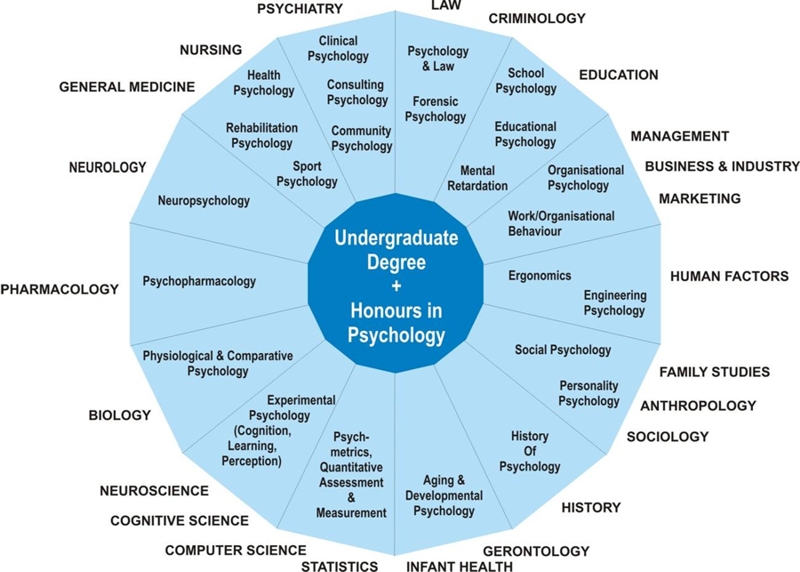
One of the main fields that Psychology majors go into is Clinical/Counseling Psychology. However, there are many different paths Psychology majors can take! Here is a list and a little information about some of the other exciting fields Psychology offers!
- Industrial Organizational Psychology
- I/O Psychology is the study of working and the application of that science to workplace issues (retention, employee satisfaction, diversity, etc.)
- http://www.siop.org
- Sports Psychology
- Sports Psychologists help athletes (professional or amateur) enhance their performance, overcome issues, and achieve their goals.
- http://www.apa.org/helpcenter/sport-psychologists.aspx
- Rehabilitation Psychology
- Rehabilitation Psychologists work with people who have disabilities and/or chronic health conditions to help them increase and maximize health, functional abilities, and more.
- http://www.div22.org/what-is-rehab-psych
- Forensic Psychology
- Forensic Psychologists assess individuals who are involved with the legal system, and much more!
- http://www.apa.org/ed/precollege/psn/2013/09/forensic-psychology.aspx
- Neuropsychology
- Neuropsychology is the study of the relationship between behavior/emotion/cognition and brain functioning.
- Subfield: Neuromarketing
- http://careersinpsychology.org/becoming-a-neuropsychologist/
- Neuropsychology is the study of the relationship between behavior/emotion/cognition and brain functioning.
- Health Psychology
- Health Psychology is the study of behavioral processes in illness, healthcare, and overall health.
- http://www.apa.org/action/science/health/education-training.aspx
- School Psychology
- School Psychologists work, mostly in a school setting, in order to better support students abilities to learn effectively, as well as support teachers to teach effectively.
- https://www.nasponline.org/about-school-psychology/who-are-school-psychologists
- Developmental Psychology
- Developmental Psychologists study lifespan development, specifically how and why humans change over the course of the lifespan.
- http://www.simplypsychology.org/developmental-psychology.html
- Experimental Psychology
- Experimental Psychologists area of study is research! These Psychologists study basics processes (cognition, learning, etc.) in animals and humans.
- http://www.apa.org/action/science/experimental/education-training.aspx
- Research/Quantitative Psychology
- In this field of Psychology, you would study methods and techniques for the measurement of human characteristics, statistical methods of psychological processes, and research designs.
- http://www.apa.org/research/tools/quantitative/
- Academia
- A lot of students who go into any of the areas listed here decide to become apart of Academia. In other words, they apply and become Professors at Universities across the globe.
- http://www.apa.org/careers/resources/academic/
- Cognitive Psychology
- Cognitive Psychology is the study of mental processes (Language, memory, problem solving, etc.).
- http://www.simplypsychology.org/cognitive.html
- Environmental Psychology
- Environmental Psychologists seeks to find the relationship between individuals and their surroundings.
- http://careersinpsychology.org/becoming-environmental-psychologist/
- Social Psychology
- Social Psychologists study individual behavior in a social environment or context.
- http://www.simplypsychology.org/social-psychology.html
Below are a few links that can help you find out more about some of the careers listed above! Please also note that this is not an extensive list, there are a lot of different careers and sub-fields you can go into with a Psychology major!
What Would You Do As a Bystander?
What causes people to help those in need? Whether it is hearing gunshots, seeing an injured or ill individual on the streets, or simply extending a helping hand, what are the factors which dictate whether or not others will offer help? Researchers John Darley and Bibb Latane (1968) asked the same questions and created the bystander intervention model based on their findings.
When Kitty Genovese was stabbed to death in the middle of a New York street with no law enforcement responding, it triggered research.
Why do bystanders not help those in need? According to Darley and Latane (1968), people responded to this question by saying they do not want to get involved, are fearful of physical harm, experience public embarrassment, or that someone else will do something to help the situation.

When there are other individuals around, there is a diffusion of responsibility. People assume that someone else has called 911 or assisted in some manner. When there is only one individual or a small group of people, they are able to discuss the situation to take action and help those in need. The responsibility to help is placed on the one individual or small group and they are more likely to take action.
The Study
In order to test and observe these hypotheses, Darley and Latane (1968) created an experimental study to observe how individuals respond in various situations.
Participants were placed in a “discussion group” about college life experiences which took place over an intercom system. During the discussion, another student in the group had a seizure, which was expressed through a recorded script. The researchers measured how quickly students responded to the situation by telling the experimenter. They tracked the number people through to be in the group and how that affected the response time.
The Results
The results of the study confirmed the above hypotheses in that 85% of those who thought they were the only ones who knew about the situation reported the seizure before the recording had stopped. However, 31% of those who thought someone else in the group would report still reported. When individuals were in a two-person study group, all of the participants reported the situation. When in the six-person discussion group, 62% of the participants reported the emergency.
Implications
These findings are consistent with the Kitty Genovese stabbing. When there are more people or a perceived greater number of people, one individual is less likely to assist as quickly or if at all compared to one individual approaching the situation.
Darley, J.M., & Latane, B. (1968). Bystander intervention in emergencies: Diffusion of responsibility. Journal of Personality and Social Psychology, 8, 377-383.
Neurons: How do they work?
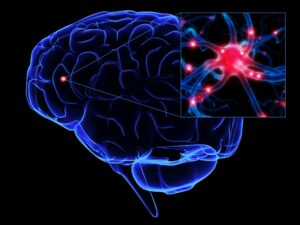

Our brain’s are made up of billions of nerve cells called neurons. These are the basic building blocks of the nervous system. To understand how our thoughts and actions, our memories and moods, we need to know how neurons work and communicate.
In 1873, Italian physician and scientist Camillo Golgi discovered a silver staining technique that is used to visualize nervous tissues under a light microscope. The method was named Golgi’s method. This was the start of studying neurons. Today, we now known more about the complexity of a neuron.
Although neurons can differ, they all consists of a cell body, dendrites, axon, and myelin sheaths. The cell body directs all activities of the neuron. This is connected to the bushy dendrite fibers that receive information, like messages, from other neurons and relay those messages toward the cell body. From there, the cell’s single axon fiber passes the message through its terminal branches from the cell body to the dendrites of other neurons or to muscles. In short, dendrites listen where as axons speak.
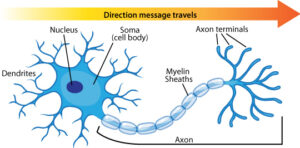
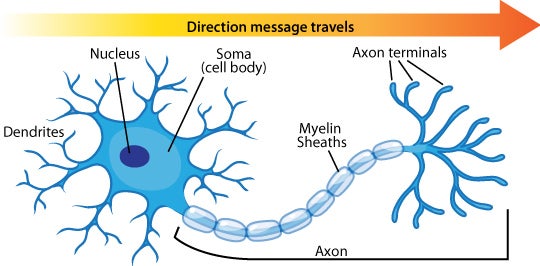
Dendrites are shorter in length where as the axons can be very long, even several feet through the body. The axons are encased in a myelin sheath, a layer of fatty tissue that insulates them and speeds up their impulses. Every moment, messages are being sent back and forth at amazing speeds from neuron to neuron.
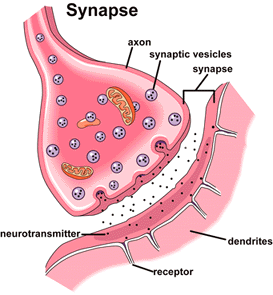

A neuron communicates with other neurons at a synapse. To send messages, a neuron releases chemical messengers, called neurotransmitters. Within 1/10,000 of a second, the neurotransmitter molecules crosses the synaptic gap and bind to a receptor sites on the receiving neuron. When neurotransmitters attach to these receptors, they cause changes inside the receiving neuron and the message is delivered.This is best visualized as a key fitting into a lock. The excess neurotransmitters then drift away, are broken down by enzymes or are reabsorbed by the sending neurons, a process called re-uptake.
Understanding neurons helps us understand how thought, memories, actions, and moods are created. They even help explain how drugs effect our brains and create addictions. The more you know about the neuron, the easier it is to explain how our brain works.
Videos
Sites
Phineas Gage
In September 1848, Phineas Gage was working as a foreman of a crew cutting a railroad bed in Cavendish, Vermont. He was 25 years old. It was on September 13, when he was using a tamping iron to pack explosive power into a hole when the powder detonated. The tempting iron, that was 43 inches (3 feet 7 inches) long, 1.25 inches in diameter and weighing 13.50 pounds, shot upwards and penetrated point first through Gage’s left cheek. It ripped into his brain and exited through his skull. The tamping iron landed about 25 yards away from him. Although this may have taken Gage’s sight from his left eye, he might not have lost consciousness. He was taken to be treated by Doctor John Martyn Harlow.
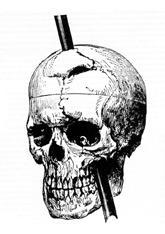

John Harlow treated Gage for months after the accident and made observations about Gage’s health and behaviors. He state,d that the balance between his “intellectual faculties and animal propensities” seemed gone. He could no longer stick to plans, uttered profanity and showed little deference for his fellows. Gage’s friends found him to be “no longer Gage,” after the accident.
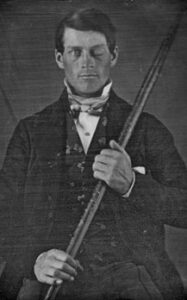
After being refused his former job as a foreman, he went to work in a stable in New Hampshire, drove coaches in Chile, until he eventually joined relatives in San Francisco. This is where he died 12 years after the accident, in May 1860, at the age of 36, after a series of epileptic seizures.
Phineas Gage became one of the most famous patients in the area of neuroscience because his case was the first to suggest a link between brain trauma and personality changes.
Videos:
- Lessons of the brain: the Phineas Gage Case (show cased above)
- The Story of Phineas Gage
- Phineas Gage and Areas Damaged in the Brain
Sites:
Neurological and Physiological Psychology at UW-Green Bay
UW-Green Bay Neurological and Physiological Psychologists
 Dr. Jason Cowell
Dr. Cowell studies the neural development of moral judgment, moral action, theory of mind, empathy, self-control, and prosocial behavior in childhood, adolescence, and adulthood. He uses electroencephalography, functional neuroimaging, psychophysiological measures, eye-tracking, and behavioral paradigms to investigate the complexities of developing morality and self-control in the US and cross-culturally. He teaches Cognitive Psychology and Cognitive Neuroscience.
Contact him at: cowellj@uwgb.edu