https://youtu.be/EwMpPZ96uLE
Learned Behaviors: Bobo Doll’s Prominent Place in Psychology
In 1961, researchers Albert Bandura, Dorothea Ross and Sheila A. Ross published an article in the Journal of Abnormal and Social Psychology titled: “Transmission of Aggression through Imitation of Aggressive Models”. This study helped many begin to understand one of the many aspects of aggression.
In this famous study, the researchers had 36 boys and 36 girls who were in the Stanford University Nursery. These children were between the ages of three to six years. In the experimental design, the children were placed into different groups. Below is a diagram of the groups:

As you can see, the children were either placed in the control group with no adult model, or one of the groups with an aggressive or non-aggressive model. The children placed with the aggressive model watched an adult, either male or female, in a room with toys. In this scenario, the adult was aggressive towards a specific toy, Bobo Doll. The adults would hit Bobo with a hammer, throw it in the air, and say hostile comments toward the inflated clown. The group that had a non-aggressive model, either male or female, watched the adult play with the toys quietly, while they ignored the Bobo Doll. The control group did not have a model to witness either aggressive or non-aggressive behaviors.
After the children had watched the video of the adult’s behavior or not watched for the control group, each of the children were taken individually to a room with appealing toys. However, as soon as each child started to play, the experimenter would enter and say that they needed to use the toys for other children. This part of the experiment was meant to increase aggression in all groups.
Lastly, the children were taken to a similar room that they had witnessed the adult model’s in, depending on their group. The room had both non-aggressive and aggressive toys for the children to play with for 20 minutes, while being observed.

The children who had witnessed an aggressive adult model were significantly more imitative and aggressive that those children who were in the control group or did not witness an aggressive model. This study went on to help support Bandura’s Social Learning Theory, which explains that children learn through watching others, including their caregivers. To hear and see some of the results yourself, watch this video:
For more information or additional resources, check these out:
- Bandura, A., Ross, D. & Ross, S.A. (1961). Transmission of aggression through imitation of aggressive models. Journal of Abnormal and Social Psychology, 63, 575-82.
- http://www.simplypsychology.org/bobo-doll.html
- http://psychclassics.yorku.ca/Bandura/bobo.htm
Learned Helplessness
Overmier and Sleigram’s (1967) exposed dogs to unavoidable electric shocks in one situation and to avoidable electric shocks in another situation. They found that dogs who had learned that they could not escape the electric shocks during a prior experience would not even try to escape in a later situation when escaping was actually possible.
Watch this video from The Awesome Life for more:
Being Sane in Insane Places
In order to observe the societal perception of those with mental illness, David Rosenhan conducted an observational study. In 1973, there was a problem with properly diagnosing patients and their mental illness. In 1973, David Rosenhan sought out to see what would happen if he placed pseudopatients in psychiatric hospitals and assessed how they were treated.
http://https://www.youtube.com/watch?v=j6bmZ8cVB4o%20
By placing eight individuals who have not been diagnosed with a mental illness in 12 different psychiatric wards across the country, Rosenhan observed how the individuals were treated while in the ward as well as after their discharge and how many days they stayed in the ward. The staff was unaware of the experiment and were under the assumption that the pseudopatients were experiencing signs of schizophrenia such as hearing voices which were unclear at times and they felt as though life was empty and hollow.
After admission, the pseudopatient ceased showing signs of their symptoms and behaved as though they would typically behave. They were unaware of when they would be discharged and had to be discharged through their own actions which took from 7-52 days. The patients were not detected as not suffering from schizophrenia but were discharged due to their good behavior and cooperation. Each of the patients were discharged with schizophrenia in remission.
https://isites.harvard.edu/fs/docs/icb.topic625827.files/On_Being_Sane_In_Insane_Places-1.pdf
Sigmund Freud: The Founder of Psychoanalysis
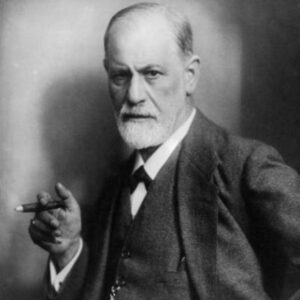

Sigmund Freud (1856-1939) was an Austrian neurologist and the founder of psychoanalysis. Although his findings and theories are very controversial, he is one of the most influence people in the field of psychology. His ideas have become interwoven into the fabric of our culture, with terms such as “Freudian slip”, “repression”, and “denial” appearing regularly in everyday language. His innovative treatments of human actions and dreams had massive implication for a wide variety of fields like psychology. He also helped push the study of the mind and greatly influenced the study and understanding of human psychological development.
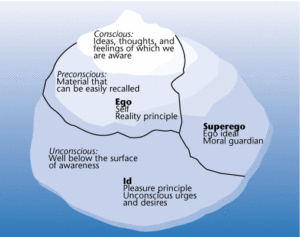
Freud’s theories and techniques led largely to evaluating our interpretations of human behavior. His theory states that we all have three parts to our personality; the id, the ego, and the superego. The id consists of basic biological urges and instincts like hunger, thirst, and sexual impulses. It also operates in the unconscious level. The ego is put in place to balance the id’s and the superego’s needs. It seeks to please the id’s drive in realistic ways. The ego is found in the unconscious and conscious. Lastly, the superego operates in the conscious and subconscious of the mind. It is alert to the real world and makes sure the demands of the id are satisfied morally.
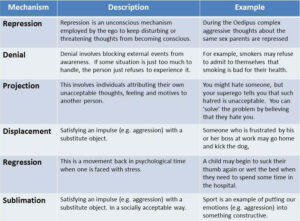
Freud’s Mechanism of Defense defense was thought of as psychological “weapons” that your ego uses to protect you from your self-created anxiety. It was used as a way to prevent your ids bad impulses from entering your consciousness. There are six different forms of defense mechanisms that Freud thought we used. The implications from this idea was that nearly everyone uses a way to help them cope at some point in their lives. It help reduce unhealthy physiological activity.
Although Freud’s work may be criticized today as non-scientific, there is no question that he had a huge impact on psychology. His ideas are now a part of public awareness, even though often we do not realize their origins are from his psychoanalytic tradition.
Sites:
The DSM-5: Diagnostic and Statistical Manual of Mental Disorders

The Diagnostic and Statistical Manual of Mental Disorders (DSM) first appeared in 1952. The goal of the DSM is the help psychiatrists, psychologists, and other clinicians diagnose patients with mental disorders.
That first version of the DSM only had 106 listed “reactions”. It also did not include child disorders, and was less than 150 pages long. It was also rooted heavily in Sigmund Freud’s psychoanalysis.
In 1968, the DSM came out with it’s second version, or DSM-2. This version listed 80 more disorders than the first DSM, including a group of disorders commonly diagnosed in childhood. This version also started to move away from psychodynamic perspective.
The DSM-3 arrived in 1980, which took on a more modern form. The goal of this DSM was to objectivity and to keep the theories unbiased/neutral. These theories were based off of field trials and experiments. They added about 100 more disorders (265), and had more than 500 pages. Seven years later, in 1987, the DSM-3-R was published, which added approximately 30 disorders.
The DSM-4 was released in 1994. The goal of this version was to have a systemic literature review, which is a review of empirical evidence of the listed disorders and treatments. The number of disorders decreased to 279. In 2000, the DSM-4-TR was published with very few revisions.
Finally, the DSM-5 was published in 2013, which is the most current DSM. The goal was to maintain consistency and continuity with the previous DSM. They made revisions based off of the scientific and empirical evidence. The disorders increased to 294, with almost 950 pages.

The categories listed in the DSM include…
- Depressive Disorders
- Anxiety/Fear Disorders
- Bipolar Disorders
- Personality Disorders
- Psychotic/Schizophrenia Disorders
- Addictive Disorders
- Feeding/Eating Disorders
- ADHD
- Autism
- Implies Control and Conduct Disorders
- Dissociative Amnesia
- And more!
For more information, check out these links!
- http://www.dsm5.org/Pages/Default.aspx
- https://psychiatry.org/psychiatrists/practice/dsm/history-of-the-dsm
- http://www.apapracticecentral.org/reimbursement/icd-10-cm/dsm-5.aspx?_ga=1.115142087.1708959200.1385078646
Suicide
What is Suicide?
Suicide is the act of killing oneself and it is most often a result of depression or other mental illness. Learn more at the American Psychological Association.
What are the Warning Signs?
Some warning signs of suicide include (learn more from the American Foundation for Suicide Prevention):

Question-Persuade-Refer

Question. Persuade. Refer. The QPR Training Program is an hour-long training session which provides the resources to aid in preventing suicide. Anyone is able to participate to in the QPR training and anyone is able to help those in need with these three steps.
Call the National Prevention Lifeline which is a 24/7 free and confidential support resource.
Find a local psychologist is a tool which finds psychologists based on your needs and location.
Brain Structures and their Function
The human brain is made up of many different parts that all have their own unique function. They work together to accomplish all functions of our lives, from memories to actions. When a part of the brain does not work properly, the consequences can be severe. With an understanding of what each part of the brain does, one can start to understand how humans function.
One of the most important parts of the brain is the cerebral cortex because it is what makes us human. It is the ultimate control and information-processing center of the brain. The cerebral cortex is the outer layer of neural tissues. This tissue plays a key role in memory, attention, perception, awareness, thought, language, and consciousness.
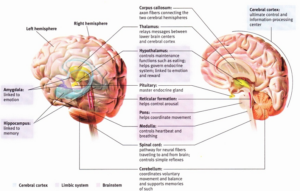
A key component of the brain is to communicate messages between neurons. To accomplish this the two hemispheres of the brain must pass messages between each other. The axon fibers that are connecting the two cerebral hemispheres together is known as the Corpus Callosum. This neural tissue facilitates communication between the two sides of the brain.
The cerebellum enabled nonverbal learning and skill memory. It is also helps us judge time module our emotions and discriminate sounds and textures. Whereas the hippocampus helps process explicit memories and helps in the storage of memories.
A very important part of the limbic system is the amygdala. It is linked to emotions, especially aggression and fear. Along with the amygdala, the hypothalamus is also linked to emotion and reward. It also controls functions, such as eating.
Additional Resources
The Price of Beliefs
It is basic nature to view ourselves in the best light possible. However, when we act in ways which do not align with our attitudes, it can lead to a feeling of discomfort. This is explained by Leon Festinger’s (1957) theory of cognitive dissonance which demonstrates how tension is experienced when behavior and attitude are inconsistent.
Festinger’s (1957) theory has been the subject of countless experiments to further understand the way in which individuals cope with tension. The results of these experiments have been beneficial for understanding persuasive arguments, social justice, and prejudice.
There are three methods to reduce this feeling of discomfort and tension when experiencing cognitive dissonance.
- Changing the behavior.
- Attempting to justify the behavior through changing the cognition.
- Attempting to justify the behavior by adding a new cognition.

For example, imagine you are watching Netflix rather than working on homework. You experience tension because you know you should be working on homework but are actively choosing not to. In order to reduce the tension of behavior and attitude being inconsistent, you will do some combination of these three things:
- Change the behavior by not watching that next episode and working on homework instead.
- Change the attitude by thinking it is okay to be watching Netflix because homework is stressful.
- The third option is to add a cognition such as telling yourself you never have time to relax and it is good to take time for yourself.
By using one or more of these three methods, cognitive dissonance will be reduced and you will feel less tension.
By justifying the attitude or the behavior, individuals are able to reduce the tension and better able to cope with the inconsistencies. The internal justification provides a reason and explanation. Every time we make decisions, we are engaging in dissonance. Many times there are doubts about the decision and there is contemplation for alternative options.
It is important to be aware of the methods to resolve the feeling of dissonance and how it impacts attitude and beliefs.
Dr. Bo Bennett further explains the theory of cognitive dissonance.
http://https://www.youtube.com/watch?v=gN-6nBs7sbI
Festinger, L. (1957). A theory of cognitive dissonance, Row Peterson.
The Functions of the Four Lobes of the Brain
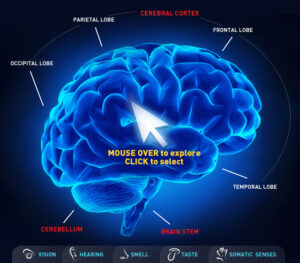
Our brains are made up of two hemispheres, the right and the left. Covering these hemispheres, is a thin surface layer of interconnected neural cells called the cerebral cortex. It is your brains thinking crown, your body’s ultimate control and information-processing center. The cerebral cortex is divided into four sections, or lobes. They include the frontal lobe, parietal lobe, occipital lobe, and temporal lobe.
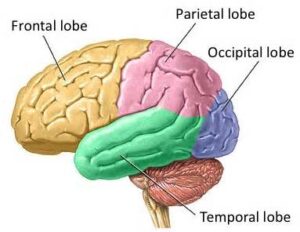
The frontal lobe is the portion of the cerebral cortex lying just behind the forehead. It is involved in speaking and muscle movements, as well as making plans and judgments. This area is best described as the control center of the brain.
Next, the parietal lobe is the portion of the cerebral cortex lying at the top of the head and toward the rear. This receives sensory input for touch and body position.
The Occipital lobe is the portion of the cerebral cortex lying at the back of the head. This area receives information from the visual fields and is associated with vision processing.
The forth lobe, the temporal lobe, is the portion of the cerebral cortex laying roughly above the ears. This includes the auditory areas, each receiving information primarily from the opposite ear.
Additional Information